
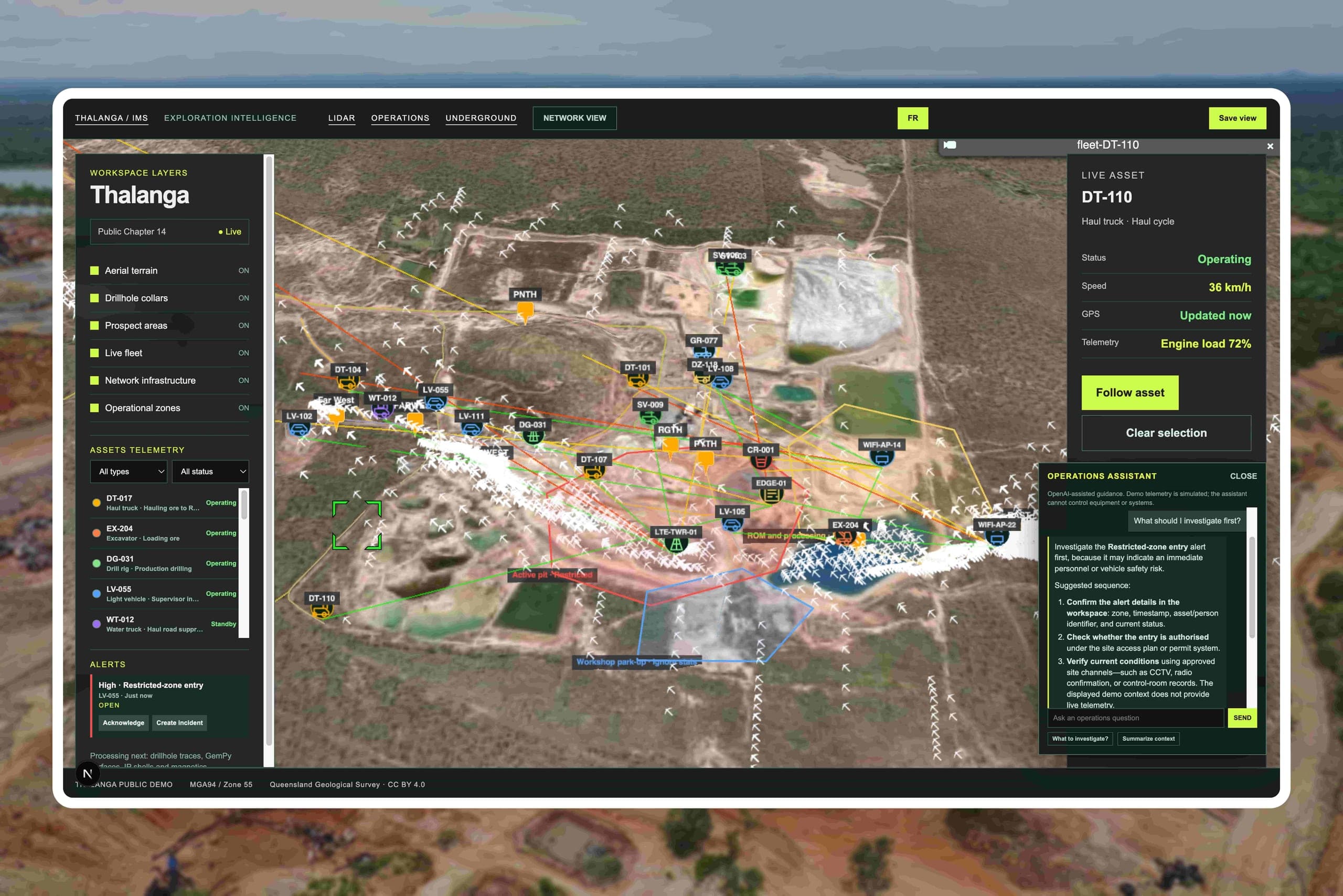
Make every mining decision count.
Grade variability affects production decisions. Equipment availability shapes schedules. Haulage constraints influence throughput. Maintenance decisions affect cost, safety, and reliability.
Edgerunners helps mining teams connect these moving parts, identify where value is created or lost, and build data-driven software around the decisions that matter most.
From problem definition to production-ready software and continuous improvement
The reality of mining operations
Mining performance is a system-level problem.
A mine rarely loses value because of one isolated issue. Performance is shaped by the interaction between geology, planning, people, equipment, material movement, processing constraints, and the quality of operational information.
A local improvement can have limited impact — or move a bottleneck elsewhere — if the wider system isn't considered.
- Ore quality and grade variabilityProduction and processing decisions depend on reliable knowledge of what is being mined, moved, blended, and delivered. Inconsistent or delayed information creates reconciliation gaps and undermines planning assumptions.See the solution
- Operational visibilityWhen production, fleet, equipment, and site data sit in disconnected tools, teams struggle to see what is happening now, why a deviation occurred, and which action should come next.See the solution
- Material movement and resource utilizationHaulage, dispatch, equipment assignment, queues, road conditions, and changing priorities influence how effectively people and machines are used.See the solution
- Planning and executionPlans are built on assumptions; actual conditions change. Comparing plan with actual, understanding deviations, and revising decisions is essential to operational control.See the solution
- Equipment availability and reliabilityMaintenance spans inspections, preventive tasks, condition monitoring, failure analysis, spare-parts readiness, and reliability-centered decisions — not just work orders.See the solution
We start by understanding how these challenges affect the whole operation — not by assuming a particular software product is the answer.
We turn complex operations into problems that can be optimized.
Each engagement is an engineering problem grounded in business value. We understand the operation, its constraints, its data, and the decisions people make every day — then map how those decisions influence operational and financial outcomes.
The goal isn't technology for its own sake. It's better decisions, executed more consistently, with a way to measure whether the change creates value.
Understand the operation
Map the process, stakeholders, constraints, current systems, data sources, and critical decisions.
Build the Value Driven Tree
Connect business outcomes — cost, throughput, recovery, equipment availability, or schedule performance — to the operational drivers that influence them.
Prioritize the highest-value opportunity
Weigh impact, feasibility, data readiness, effort, and operational risk. Select a realistic first use case rather than transforming everything at once.
Engineer, validate, and improve
Build or integrate the software and analytics, validate them under real operating conditions, support adoption, and track the agreed measures.
Mining challenges & solutions
Start with the challenge that matches your role.
Each domain follows the same path: the operational problem, where value is lost, what we can engineer, and the decisions it supports.
01 / Grade control & ore quality
Make grade decisions with better operational context.
Grade control connects geological understanding with day-to-day mining execution: estimating and tracking material characteristics, distinguishing ore from waste, managing dilution and ore loss, supporting selective mining, and reconciling what was planned with what was mined and processed.
The challenge isn't collecting more grade data. It's keeping a reliable connection between geological models, sampling and assay results, block or dig-unit definitions, material movement, stockpiles, blending, and plant outcomes — with the timeliness and confidence the operation needs.
Intended outcomes: Better material visibility, more consistent reconciliation, earlier detection of deviations, and more informed decisions around ore quality and material handling.
Where value can be lost
- Differences between planned, mined, hauled, stockpiled, and processed material
- Delayed or inconsistent sampling, assay, and production information
- Limited traceability of material from source to destination
- Dilution and ore loss that are hard to detect or quantify in time
- Poor visibility into grade variability and its consequences
- Decisions based on disconnected geological, dispatch, and processing data
What we can engineer
- Workflows connecting geological, sampling, production, and material-movement data
- Grade-control dashboards and exception views
- Reconciliation across plan, execution, stockpiles, and processing
- Material traceability and data-quality checks
- Analytical models to find patterns, estimate uncertainty, or flag deviations — when appropriate data and validation exist
- Decision support for selective mining, stockpiles, and blending
Decisions this can support
- Which material should be mined next?
- Where is actual grade diverging from the plan?
- Which sources or destinations need investigation?
- How should material be tracked, segregated, or blended?
- Which reconciliation gaps are significant enough to act on?
02 / Operational monitoring & situational awareness
Know what is happening — and what needs attention.
Mining teams work across production, fleet movement, equipment status, safety-related events, environmental conditions, stockpiles, processing, and site infrastructure. The data may exist, but it can be delayed, fragmented, hard to interpret, or disconnected from the action required.
Effective monitoring is more than a wall of dashboards. It connects trustworthy data to meaningful indicators, deviations, responsible teams, and a clear response process.
Intended outcomes: Faster situational awareness, less manual reporting, more consistent operational reviews, and clearer accountability for follow-up actions.
Where value can be lost
- Teams working from different versions of operational truth
- Deviations discovered after their impact has grown
- Manual reporting that consumes time and delays action
- Alerts that create noise without severity or ownership
- Events that can't be traced to causes or resolution
- Site decisions without a consistent view of relevant KPIs
What we can engineer
- Unified dashboards bringing selected data sources into one view
- Near-real-time monitoring where source systems and connectivity support it
- KPI tracking, trend analysis, and plan-versus-actual views
- Threshold-based alerts and exception workflows
- Event timelines, escalation paths, and action tracking
- Data-quality and system-health monitoring to separate operational problems from missing data
- Anomaly detection where the data supports a reliable model
Decisions this can support
- Which production or equipment deviations need immediate attention?
- Where is the operation drifting from its targets?
- Which alerts require action, and who owns the response?
- Is this an isolated event or a recurring pattern?
- Which indicators best explain a performance gap?
03 / Logistics, dispatch & resource allocation
Put equipment, people, and material where they create the most value.
Mining logistics is a changing network of loading points, haul roads, dumps, stockpiles, crushers, equipment, operators, and production priorities. Travel times, queues, availability, road conditions, fuel use, and shifting constraints make resource allocation difficult.
A dispatch decision should be evaluated in the context of the wider operation. Maximizing one machine's utilization doesn't necessarily maximize system throughput if it increases queues or starves another part of the process.
Intended outcomes: More informed resource allocation, better understanding of cycle times, less avoidable waiting, and closer alignment between equipment use and production priorities.
Where value can be lost
- Excessive waiting and queueing
- Unbalanced assignment of trucks, loaders, and other equipment
- Long or inefficient haul cycles
- Poor coordination between production targets and availability
- Resource conflicts across work areas and shifts
- Limited visibility into causes of cycle-time variation
- Static assumptions despite changing site conditions
What we can engineer
- Fleet and material-movement dashboards
- Cycle-time analysis and bottleneck identification
- Dispatch and allocation decision support
- Constraint-aware scheduling and resource assignment
- Scenarios for equipment availability, route changes, and priorities
- Optimization models where objective, constraints, and data are well defined
- Integration with fleet-management, positioning, and planning systems where supported
Decisions this can support
- Which resource should serve which task or destination?
- Where are queues or idle periods reducing performance?
- Which constraint is limiting throughput right now?
- How would a change in fleet availability or routes affect the plan?
- Which allocation best balances throughput, cost, and constraints?
04 / Mine planning & plan-to-actual control
Connect the mine plan to what actually happens on site.
Mine planning translates geological, production, equipment, workforce, and commercial constraints into schedules and targets. Then plans meet reality: downtime, geological variation, weather, access constraints, workforce changes, processing limits, and shifting priorities.
The challenge isn't only producing a plan. It's understanding where execution diverges, why, how it affects downstream activities, and which adjustment is most useful.
Intended outcomes: More transparent execution, earlier identification of schedule risk, faster performance reviews, and better-informed replanning.
Where value can be lost
- Plans and actuals reviewed in separate tools
- Variances reported without their operational drivers
- Changes in one area with unrecognized downstream effects
- Scheduling assumptions not updated when constraints change
- Significant time spent consolidating progress reports
- Scenario comparisons that are hard to reproduce or communicate
What we can engineer
- Plan-versus-actual dashboards and reporting workflows
- Schedule, milestone, and production KPI tracking
- Variance classification and root-cause workflows
- Constraint and dependency visualization
- Scenario modeling under defined assumptions
- Integration of planning, production, maintenance, and reporting data
- Forecasting where sufficient historical and current data exists
Decisions this can support
- Which targets or milestones are at risk?
- What explains the gap between planned and actual?
- Which constraint should be addressed first?
- What is the likely effect of a schedule change?
- Which assumptions need updating before the next cycle?
05 / Maintenance, asset health & reliability
Move from reactive repairs to reliability-led decisions.
A Computerized Maintenance Management System (CMMS) organizes assets, work orders, inspections, spare parts, and history. Reliable performance also depends on preventive maintenance, condition monitoring, failure analysis, planning and scheduling, root-cause analysis — and, where data and engineering context support it, predictive analytics and reliability-centered maintenance.
Digitalizing work orders is a useful foundation, but it isn't predictive maintenance. The right approach depends on asset criticality, failure modes, data quality, sensor coverage, maintenance practices, and the cost of failure.
Intended outcomes: Better maintenance visibility, more structured work execution, better-informed asset prioritization, and a stronger foundation for reliability improvement.
Where value can be lost
- Incomplete asset registers or inconsistent histories
- Repeated failures without structured root-cause analysis
- Preventive tasks misaligned with criticality or failure modes
- Unplanned downtime and emergency work
- Plans disrupted by unavailable labor, tools, or spare parts
- Condition data collected but not connected to decisions
- Predictive models not validated against actual failures
What we can engineer
- CMMS workflows for assets, work orders, inspections, preventive plans, and history
- Asset hierarchy, criticality, and maintenance KPI dashboards
- Work planning, scheduling, and spare-parts coordination
- Failure coding, root-cause analysis, and recurring-failure monitoring
- Integration of condition-monitoring and sensor data where available
- Anomaly detection and failure-risk models with enough representative data
- Decision support linking model outputs to inspection and planning workflows
Decisions this can support
- Which assets deserve the highest maintenance priority?
- Which work should be planned before the next operating window?
- Which failures recur, and what do they share?
- Is a preventive task effective, or should its strategy change?
- Which condition signals warrant inspection?
- When does the risk of continued operation justify intervention?
A practical maintenance maturity model
Level 3 — Planned & scheduled maintenance
Better work identification, prioritization, job plans, labor and equipment coordination, shutdown planning, and spare-parts readiness.
A practical communication framework, not a universal standard. Real maintenance strategies often combine several levels across different assets.
The greatest opportunity often lies between systems.
Grade control, planning, dispatch, monitoring, and maintenance are often bought as separate software. On site, they influence one another. We can start with one defined use case and expand when the business case, data readiness, and operating model justify it.
If asset reliability changes
Select any link to see how a change there can travel downstream. An illustrative chain — real relationships depend on the operation.
The objective isn't to put every function into one application by default. It's to make the right information available to the right decision at the right time — without losing sight of local operational realities.
How we build value · Value Driven Tree
Start with value. Work back to the variables.
Before recommending a technology, we define with stakeholders what “better” means for the operation. The VDT connects business outcomes to the drivers and decisions that influence them — separating high-impact opportunities from attractive but low-priority ideas.
Business outcome
Reduce avoidable haulage cost while protecting production targets
Potential drivers
- Average haul cycle time
- Queue and waiting time
- Fleet availability
- Payload and utilization
- Route conditions and distance
- Fuel or energy consumption
- Loading and dumping constraints
Potential interventions
- Improve cycle-time visibility
- Identify the most significant source of delay
- Test alternative resource allocations
- Coordinate dispatch priorities with equipment availability
- Measure the operational and financial effect
Measured result
Compared against an agreed baseline
The actual VDT is built from the mine's process, data, constraints, and objectives.
Define the business outcome
For example: reduce cost per tonne, increase throughput within existing constraints, improve recovery or availability, reduce unplanned downtime, or improve schedule adherence.
Decompose into drivers
Map the operational variables that influence the outcome — cycle time, queue time, availability, dilution, ore loss, energy, maintenance backlog, or process variability.
Identify controllable decisions
Separate variables that operational decisions can influence from external conditions and constraints that must be managed.
Estimate the value of improvement
Use available operational and financial data to estimate potential impact. Make assumptions and uncertainty visible; validate with domain experts.
Prioritize an actionable use case
Compare impact with feasibility, data readiness, cost, risk, and time to learn. Choose a first step that can be tested and measured.
Measure and refine
Compare against a baseline, learn from real operating conditions, and update the model and solution as evidence improves.
Instead of “Where can we use AI?”, we ask: which decision or constraint matters most — and what evidence would show that improving it creates value?Build a VDT for your operation
A practical engagement process
Start with one important operational question.
You don't need a fully specified transformation program. We begin with a focused challenge, understand the current process, and determine whether there's a practical opportunity worth pursuing.
Discover
We discuss the operating context, the decision or workflow that needs improvement, the stakeholders involved, and current constraints.
Map the value
We outline the business outcome, operational drivers, available evidence, and assumptions to validate — where appropriate, an initial Value Driven Tree.
Assess feasibility
We review data availability, system boundaries, integration requirements, operational risks, and the likely path to a useful first result.
Define a practical next step
A technical assessment, data review, prototype, integration plan, or scoped implementation proposal — whichever fits the problem.
A first meeting is for understanding the problem and evaluating fit — not for committing to a large implementation. If we aren't the right team for the problem, we'll say so early.
Bring us the constraint. Let's explore the opportunity.
Tell us where the operation is losing time, visibility, reliability, or value. We'll use the first conversation to understand the context, identify the decisions that matter, and judge whether a data, software, or optimization approach could help.
Suggested meeting topics
- Grade variability, material tracking & reconciliation
- Production monitoring & operational reporting
- Fleet movement, dispatch & resource allocation
- Mine planning & plan-to-actual performance
- Maintenance workflows, asset health & reliability
- Connecting operational systems & fragmented data
- Prioritizing AI or optimization with a Value Driven Tree
FAQ
Questions mining teams ask first.
Do we need to replace our existing mining software?
Not necessarily. Depending on the problem, the best approach may be to improve an existing workflow, connect systems, build a focused application, or add an analytical capability. The right option depends on current systems, technical constraints, and the value case.
Do we need clean, complete data before starting?
Not always. A first assessment can establish what data exists, what is trustworthy, and which gaps matter. Some use cases need extensive historical or sensor data; others can begin with process mapping and a limited set of operational records.
Does every mining problem need AI?
No. Clearer workflows, better integration, reliable reporting, and well-designed decision support may create more value than a complex model. AI or optimization is introduced when it suits the problem and can be validated.
Can you support both surface and underground mining?
Applicability depends on the mining method, workflows, systems, data, and site constraints. We assess the context before proposing a solution rather than assuming one implementation fits every mine.
How do you evaluate whether a project is worth doing?
We define the target business outcome, map the drivers that influence it, estimate the potential value with explicit assumptions, assess feasibility and risk, and agree on measures for evaluating the result.
What happens after the first meeting?
If there is a good fit, the next step may be a focused assessment, a data and systems review, a Value Driven Tree workshop, a prototype, or a scoped proposal. It depends on the problem — not a predetermined sales package.
We don't start with technology and search for a use case. We start with the value the operation needs to create — and engineer toward it.