
Edgerunners
EdgeMine mining operations and intelligence platform overview
Mining intelligence / EdgeMine by Edgerunners

EdgeMine

AI-Powered Mining Operations, Intelligence & Optimization

EdgeMine is an integrated mining intelligence platform that connects geological models, grade control, fleet operations, maintenance, project schedules, resource allocation, and financial performance in a unified operational environment.

Platform overview

Connected operations. Shared intelligence. Measurable business value.

By integrating data across mine planning, field operations, processing, and enterprise systems, EdgeMine helps mining organizations reconcile planned versus actual performance, identify operational bottlenecks, anticipate risks, and evaluate decisions against production, cost, recovery, and profitability targets.

  • Connected operations

    Geological models, grade control, fleet operations, maintenance, schedules, resources, and finance in one operational environment.

  • Shared intelligence

    Dashboards, engineering analytics, machine learning, computer vision, and AI-powered decision support.

  • Measurable business value

    Decisions evaluated against production, cost, recovery, and profitability targets.

Start with the value driver

Engineering Mining Decisions Around Business Value

At Edgerunners, we model business challenges using a Value-Driven Tree: decomposing strategic objectives into measurable value drivers, operational variables, constraints, and decision parameters. Where appropriate, these relationships are translated into mathematical models, optimization problems, and predictive systems.

For mining operations, this may mean connecting ore grade and recovery to metal production and revenue; equipment availability and utilization to production capacity; or haulage performance, fuel consumption, and maintenance costs to unit operating cost.

Value-Driven Tree / Illustrative relationships
Strategic objective
Metal production & revenue
Ore gradeTonnageRecovery
Production capacity
Equipment availabilityUtilization
Unit operating cost
HaulageFuelMaintenance

EdgeMine provides a foundation for analyzing these relationships across your operation. Every mine has different geology, equipment, workflows, contractual arrangements, and economic constraints. Our solution architecture and analytical models are therefore tailored to your operational context rather than imposed as a one-size-fits-all system.

Bring us your operational challenge. We will work with your technical and business teams to define the problem, identify the data required, establish measurable success criteria, and propose a practical modeling and implementation approach.

The platform

Core Capabilities

Open a capability to see its key features, the business value it targets, and the KPIs used to measure it.
01 / Core capabilityGrade Control & Production ReconciliationTurn geological variability into operational control.

Turn geological variability into operational control.

Ore grade, tonnage, dilution, ore loss, and metallurgical recovery directly influence the economic performance of a mining operation. Variability in these parameters can affect production targets, processing performance, stockpile composition, blending decisions, and sales commitments.

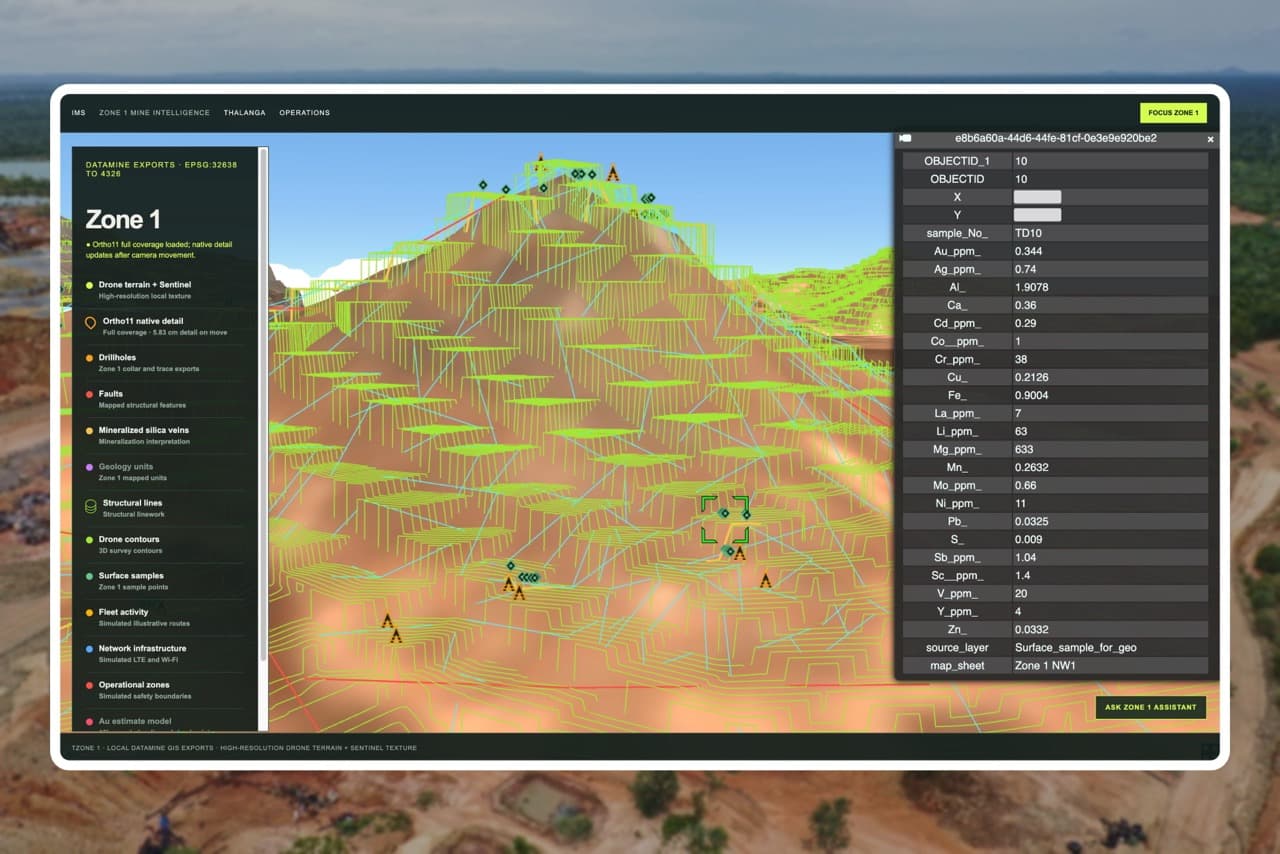
EdgeMine connects geological models, exploration results, drilling and sampling data, assay results, mine plans, dispatch records, and plant measurements to improve visibility into material movement and quality from the mining face to the processing plant.

Key capabilities

Grade estimation and spatial analysis
Integrate drillhole, sampling, geological, and assay data with block models and spatial information to support geological interpretation and grade estimation.
Ore and waste classification
Compare planned material classifications with field observations, sampling results, and operational records.
Mine-to-mill reconciliation
Compare planned versus actual tonnes and grades across mined material, stockpiles, plant feed, and processed output, accounting for measurement uncertainty and reporting periods.
Dilution and ore-loss analysis
Track deviations between planned and mined material to identify potential losses in ore value and mining selectivity.
Stockpile and blending optimization
Estimate stockpile composition and evaluate blending strategies against plant feed specifications, recovery, throughput, and product-quality constraints.
Predictive grade analytics
Forecast grade variability and potential production deviations where historical data, geological models, and sampling coverage support reliable predictions.

Business value

Improve confidence in production forecasts, reduce avoidable ore loss and dilution, support more consistent plant feed, and identify the operational causes of reconciliation gaps.

Relevant KPIs: Mined and processed tonnes, head grade, dilution, ore loss, metal recovery, reconciliation variance, and contained metal.

02 / Core capabilityMaintenance & Asset Reliability (CMMS / EAM)Move from reactive repairs to risk-informed asset reliability.

Move from reactive repairs to risk-informed asset reliability.

Unplanned equipment downtime can disrupt production schedules, reduce fleet availability, increase maintenance expenditure, and create downstream bottlenecks. Effective maintenance requires more than collecting sensor readings: it requires understanding equipment condition in the context of duty cycles, operating conditions, failure history, maintenance actions, and production criticality.

EdgeMine integrates Computerized Maintenance Management Systems (CMMS), Enterprise Asset Management (EAM) systems, equipment telematics, inspection records, work orders, and operational data to support a more proactive maintenance strategy.

Key capabilities

Asset performance monitoring
Track availability, utilization, downtime, mean time between failures (MTBF), mean time to repair (MTTR), and maintenance cost by asset and equipment class.
Failure pattern analysis
Identify recurring failures, contributing operating conditions, and maintenance-related patterns across similar assets.
Predictive maintenance
Estimate failure risk or remaining useful life when sufficient historical failure, maintenance, and condition-monitoring data are available.
Anomaly detection
Detect deviations in engine, hydraulic, vibration, temperature, pressure, fuel, and other telemetry signals, including multivariate patterns that fixed thresholds may miss.
Maintenance planning
Prioritize work orders according to asset criticality, failure risk, safety implications, spare-parts availability, and production impact.
Maintenance effectiveness analysis
Evaluate whether maintenance interventions reduce repeat failures, downtime, and lifecycle costs.
Reliability-centered maintenance (RCM)
Support the identification of critical failure modes and the selection of appropriate preventive, predictive, inspection-based, or corrective maintenance strategies.

EdgeMine can help progress maintenance maturity from reactive maintenance toward condition-based and predictive approaches. Predictive models complement established engineering practices, OEM recommendations, and safety procedures; they do not automatically replace them.

Business value

Reduce avoidable downtime, improve maintenance resource utilization, minimize repeat failures, and align maintenance priorities with production requirements.

Relevant KPIs: Mechanical availability, operational availability, MTBF, MTTR, unplanned downtime, maintenance cost per operating hour, repeat-work-order rate, and schedule compliance.

03 / Core capabilityProject Management & Operational PlanningConnect schedules, field progress, resources, and financial performance.

Connect schedules, field progress, resources, and financial performance.

Mining projects and operational programs are influenced by interdependent variables: equipment availability, workforce capacity, weather, ground conditions, contractor performance, material availability, permitting, and changing production priorities.

When project schedules, Primavera P6 plans, spreadsheets, maintenance systems, procurement records, and field reports remain disconnected, management teams can struggle to establish a consistent view of progress, forecast completion dates, or understand the cost and schedule consequences of operational changes.

EdgeMine connects project controls and operational data to create a shared, continuously updated view of planned versus actual performance.

Key capabilities

Integrated project controls
Consolidate schedule activities, milestones, budgets, commitments, actual costs, progress measurements, and resource requirements.
Schedule and cost variance analysis
Identify delayed activities, cost overruns, critical-path exposure, and deviations from baseline plans.
Resource-constrained scheduling
Evaluate work sequences against equipment, workforce, contractor, and material availability.
Scenario analysis
Compare alternative schedules, production targets, maintenance windows, and resource-allocation strategies.
AI-assisted forecasting
Estimate completion dates, cost at completion, and schedule risks using project progress, historical performance, and relevant operational constraints.
Risk and dependency analysis
Identify activities whose delays or resource conflicts could materially affect downstream milestones.
Management reporting
Generate consistent operational and executive reports from shared, traceable data rather than manually reconciled departmental spreadsheets.

From departmental data to enterprise intelligence

EdgeMine can use a centralized analytical data platform, including a data lakehouse architecture where appropriate, to integrate structured and unstructured data from operational systems.

This creates a common analytical foundation linking field-level activities to departmental performance, project outcomes, and executive objectives. AI-assisted scenario analysis can then help teams evaluate trade-offs before committing resources or changing plans.

Business value

Improve schedule predictability, reduce reporting overhead, increase cross-departmental coordination, and make the cost and operational consequences of decisions more transparent.

Relevant KPIs: Schedule variance, cost variance, estimate at completion, milestone adherence, resource utilization, critical-path delay, and forecast accuracy.

04 / Core capabilitySite Monitoring & Situational AwarenessBring field activities, equipment, and safety events into one operational view.

Bring field activities, equipment, and safety events into one operational view.

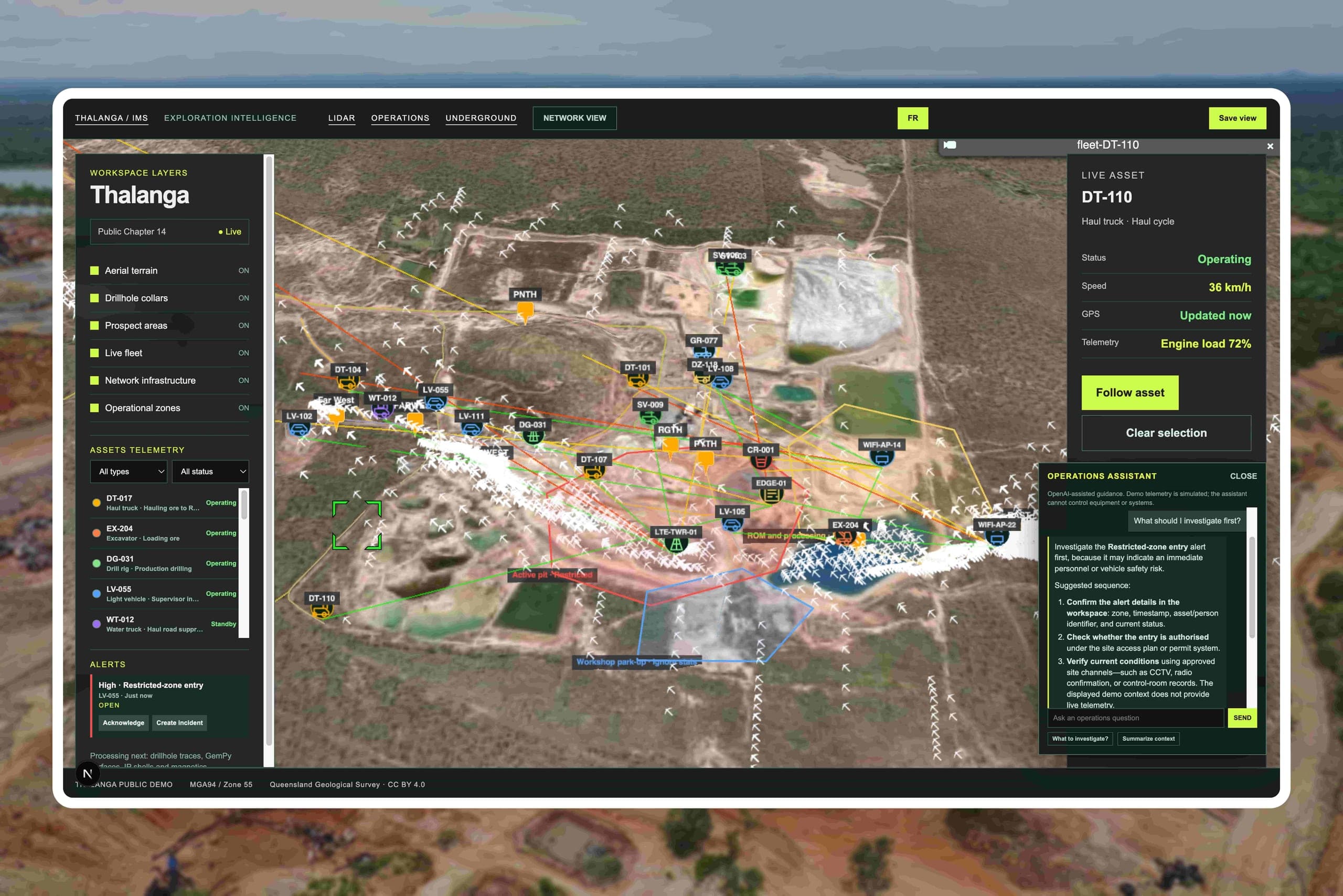
Mining operations generate data from CCTV cameras, mobile equipment, GNSS devices, environmental sensors, access-control systems, and custom industrial hardware. When these sources operate independently, important events can be difficult to correlate with production, safety, maintenance, and dispatch records.

EdgeMine brings supported monitoring sources into a centralized dashboard, connecting spatial context, equipment identity, event timestamps, and operational records.

Key capabilities

Centralized video monitoring
View supported camera streams and review recorded events according to system permissions and retention policies.
Fleet location and movement
Visualize equipment positions, movement history, geofences, routes, and operating zones using available GNSS and telematics data.
Operational event detection
Identify selected events such as unauthorized access to restricted zones, unsafe proximity, missing required PPE, or unexpected loading and unloading activity.
Equipment and process monitoring
Integrate telemetry and sensor readings to identify operating deviations and unusual site conditions.
Event correlation
Associate detected events with equipment, locations, shifts, work orders, dispatch records, and production activities where identifiers and timestamps permit.
Incident review and traceability
Support event investigation through time-stamped records, alerts, and relevant video or telemetry evidence.

AI-based detections should be validated against site conditions, camera placement, lighting, dust, occlusion, and the site's safety rules. Automated alerts support human supervision and established safety systems rather than replacing them.

Business value

Improve operational visibility, accelerate incident investigation, strengthen compliance monitoring, and reduce the time required to identify and respond to critical events.

05 / Core capabilityLogistics & Resource AllocationOptimize the movement of material, equipment, and people.

Optimize the movement of material, equipment, and people.

Haulage and resource-allocation decisions influence production throughput, fuel consumption, equipment utilization, queueing, and operating costs. Their effectiveness depends on interactions between loading units, haul trucks, routes, dump locations, shift plans, road conditions, and processing capacity.

EdgeMine integrates dispatch data, fleet telemetry, GNSS positions, production targets, maintenance availability, and resource constraints to support operational planning and optimization.

Key capabilities

Fleet utilization analysis
Measure productive hours, idle time, delays, queueing, travel time, payload, and equipment utilization.
Haul-cycle analysis
Break down loading, loaded travel, dumping, empty travel, and waiting time to identify cycle-time losses.
Dispatch and assignment optimization
Evaluate truck-to-shovel assignments and destination choices against equipment capacity, travel times, material requirements, and production priorities.
Route and road-performance analysis
Analyze travel patterns, road conditions, gradients, speeds, and congestion to identify haulage inefficiencies.
Fuel and energy optimization
Relate consumption to payload, distance, elevation change, idle time, driving behavior, and equipment condition.
Workforce and equipment planning
Align resource allocation with shift schedules, qualifications, availability, maintenance windows, and operational priorities.
What-if analysis
Compare alternative fleet configurations, production targets, and dispatch policies before implementation.

Optimization models can account for real-world constraints such as payload limits, equipment compatibility, road restrictions, safety requirements, blending targets, and crusher capacity.

Business value

Increase productive utilization, reduce unnecessary idle time and fuel consumption, improve haulage efficiency, and align fleet deployment with production objectives.

Relevant KPIs: Tonnes moved per operating hour, haul-cycle time, payload utilization, idle-time ratio, fuel consumption per tonne-kilometer, queue time, and cost per tonne moved.

EdgeMine connected mining analytics and operational workflows
Beyond dashboards

From fragmented site data to actionable intelligence

The platform combines operational dashboards, engineering analytics, machine learning, computer vision, and AI-powered decision support to turn fragmented site data into actionable operational intelligence.

Explore AI & decision intelligence

06 / Artificial intelligenceArtificial Intelligence & Decision IntelligenceMove beyond dashboards to explainable, data-driven decisions.

Move beyond dashboards to explainable, data-driven decisions.

EdgeMine incorporates AI capabilities across geological, operational, maintenance, safety, and management workflows. Models and agents are selected according to the problem, the available data, the cost of incorrect predictions, and the operational consequences of recommendations.

6.1Large Language Models (LLMs) & AI Agents

Enable technical teams and managers to query operational data using natural language, retrieve relevant documentation, investigate trends, and generate structured reports.

Potential applications

Conversational operational intelligence
Ask questions such as, “What caused the increase in haulage cost per tonne last week?” and receive an evidence-backed analysis from authorized operational data.
Cross-system investigation
Correlate production, grade-control, maintenance, dispatch, safety, and project records to investigate operational problems.
Technical knowledge retrieval
Search equipment manuals, standard operating procedures, geological reports, inspection records, and maintenance histories.
Automated reporting
Generate shift summaries, production variance reports, maintenance reviews, and executive briefings.
Workflow assistance
Prepare work-order drafts, flag missing records, summarize incidents, and recommend next steps for human review.

Data access controls, source citations, query validation, and audit logging help keep AI responses traceable and aligned with users' permissions. Actions affecting production, safety, finances, or equipment should require appropriate authorization.

6.2Computer Vision

Extract operational events and measurements from CCTV, drone imagery, and other visual data sources.

Potential applications

  • PPE compliance detection, such as hard hats and high-visibility clothing.
  • Detection of people entering restricted areas or approaching moving machinery.
  • Loading and unloading event recognition.
  • Vehicle, equipment, and activity classification.
  • Stockpile surface analysis and volumetric estimation from suitable imagery.
  • Road-condition and visible infrastructure inspection.
  • Equipment damage or abnormal visual-condition screening.

Where appropriate, detections can be linked to site maps, equipment records, and incident-management workflows. Accuracy depends on camera geometry, image quality, environmental conditions, and validation against real site data.

6.3Time-Series Forecasting

Forecast operational variables that evolve over time, helping teams anticipate deviations rather than respond only after they occur.

Potential applications

  • Ore-grade and production forecasting using geological information, sampling history, and production data.
  • Equipment demand, fuel consumption, and energy-use forecasting.
  • Maintenance-demand and downtime forecasting.
  • Plant throughput and selected process-variable forecasting.
  • Project cost, completion-date, and resource-demand forecasting.

Models are evaluated against appropriate historical baselines and out-of-sample data. Forecasts should include uncertainty estimates where feasible and be monitored for performance degradation as operating conditions change.

6.4Multivariate Anomaly Detection & Predictive Failure Analysis

Detect abnormal operating patterns across equipment telemetry, even when individual sensor readings remain within conventional thresholds.

Fixed-threshold Condition-Based Maintenance (CBM) is useful for known limits and measurable failure indicators. However, some failures develop through combinations of signals, changes in operating patterns, or deviations that are difficult to capture with a single threshold.

EdgeMine can analyze multivariate telemetry, operating regimes, signal trends, and frequency-domain features to identify patterns associated with abnormal equipment behavior.

Potential applications

  • Early identification of unusual engine, hydraulic, transmission, vibration, and thermal behavior.
  • Detection of abnormal fuel consumption and operating inefficiencies.
  • Identification of recurring failure precursors across similar equipment.
  • Risk-based maintenance alerts and inspection recommendations.
  • Reduction of unnecessary inspections or work orders through better evidence-based prioritization.

Frequency-domain analysis can be particularly useful for suitable vibration and rotating-equipment signals. Its effectiveness depends on sensor sampling rates, signal quality, equipment operating conditions, and known or validated failure patterns.

Business value

Earlier investigation of potential failures, improved maintenance prioritization, and fewer avoidable disruptions without relying exclusively on fixed sensor thresholds.

6.5Optimization & Reinforcement Learning

Evaluate resource-allocation policies and operational decisions against defined objectives and constraints.

Depending on the problem, EdgeMine may use mathematical optimization, simulation, heuristics, or reinforcement learning (RL). Reinforcement learning is not automatically the best choice; it is most relevant when decisions are sequential, operational conditions change over time, and a suitable environment for policy evaluation is available.

Potential applications

  • Dynamic truck-to-shovel assignment.
  • Haulage and dispatch policy optimization.
  • Production planning under changing equipment availability.
  • Maintenance scheduling and resource allocation.
  • Energy-aware operating strategies.
  • Coordination between production targets, stockpile blending, and processing constraints.

Models can be evaluated in historical replay, simulation, or controlled pilot environments before operational deployment. Safety rules, equipment limits, production constraints, and human approval remain explicit parts of the decision process.

Business value

Better resource utilization, improved throughput, reduced operating costs, and more consistent decisions under changing operational conditions.

07 / Connected mining hardwareEdgeMine-Eye | Connected Mining HardwareExtend operational intelligence to the field.

Extend operational intelligence to the field.

Proposed device concept

EdgeMine-Eye is a proposed ruggedized field-monitoring device concept that connects vehicle positioning, onboard sensing, visual monitoring, and local data collection with the EdgeMine platform.

Designed for applications where equipment operates across large sites with intermittent connectivity, the device can collect time-stamped field data locally and synchronize it with the central platform when connectivity becomes available.

  • GNSS & telemetry
  • Onboard camera
  • Acoustic sensing
  • Offline storage

Positioning & movementGNSS & Equipment Telemetry

Capture equipment location and movement using a suitable GNSS receiver, with optional integration into vehicle telematics and onboard systems.

Potential applications

  • Fleet tracking and geofence monitoring.
  • Speed, acceleration, and route analysis.
  • Haul-cycle and equipment-utilization analysis.
  • Road-gradient and elevation profiling when suitable positioning accuracy and correction services are available.
  • Integration of vehicle operating parameters, including fuel consumption and engine diagnostics, where supported by the vehicle interface.

High-precision surveying, slope monitoring, and engineering-grade measurements may require RTK-capable GNSS, appropriate antennas, calibration, and additional survey instrumentation. Standard GNSS alone should not be treated as a substitute for certified geotechnical monitoring.

Visual monitoringOnboard Camera

Capture visual data from vehicles or selected field locations to support operational monitoring.

Potential applications

  • Loading and unloading event detection.
  • Visual inspection of selected equipment conditions.
  • Detection of unauthorized access or activity in designated zones.
  • Monitoring of vehicle surroundings and operational events.
  • Investigation of potential material loss or suspicious loading activity, subject to suitable camera coverage and verification.

Video analytics can flag possible events for review; they cannot reliably establish theft or intent without corroborating evidence.

Sound & conditionAcoustic Sensing

Collect engine and equipment sounds using an appropriate microphone and processing pipeline.

Potential applications

  • Screening for changes in engine or mechanical sound patterns.
  • Detection of selected acoustic events.
  • Correlation of acoustic anomalies with telemetry and maintenance records.

Acoustic monitoring may help identify unusual behavior, but reliable diagnosis requires validation for each equipment class and consideration of background noise, mounting position, and operating conditions.

Store, buffer & synchronizeEdge Storage & Offline Synchronization

Store selected telemetry, event metadata, and camera or acoustic records locally when network connectivity is unavailable.

The device can then synchronize buffered data with EdgeMine when a connection becomes available, using configurable retention policies and data-prioritization rules.

Implementation considerations

  • Store-and-forward synchronization with retry and duplicate protection.
  • Local timestamps and consistent device identity.
  • Configurable video and telemetry retention.
  • Encryption, access control, and secure device provisioning.
  • Health monitoring for storage, power, connectivity, and sensor availability.

From Connected Devices to Fleet Intelligence

EdgeMine-Eye extends the platform's analytical capabilities into the field, creating a feedback loop between equipment activity, operational performance, maintenance planning, and management decisions.

The outcome: better visibility into what is happening on site, more reliable operational data, and stronger evidence for decisions about production, maintenance, fuel efficiency, and resource allocation.

From challenge to realized value

A Measurable Approach to Mining Intelligence

EdgeMine is not simply a collection of dashboards or AI models. Its value comes from connecting technical data to the economic and operational drivers that matter to your mine.

Our implementation approach begins with the business problem and works backward to the required data, models, workflows, and operational changes.

  1. Define the value driver

    Identify the target outcome, such as reducing cost per tonne, increasing equipment availability, improving grade reconciliation, or reducing schedule variance.

  2. Map the operational dependencies

    Identify the variables, constraints, responsible teams, and relationships that influence the outcome.

  3. Assess data readiness

    Evaluate data availability, quality, consistency, historical coverage, and integration requirements.

  4. Build the analytical solution

    Select suitable engineering calculations, statistical models, optimization methods, machine learning, or AI agents.

  5. Validate against operational reality

    Establish baselines, compare predictions with actual outcomes, and involve domain experts in validation.

  6. Integrate into daily workflows

    Deliver results through dashboards, alerts, reports, and authorized operational workflows.

  7. Measure realized value

    Track agreed KPIs and compare performance against the baseline, accounting for relevant operational changes and external factors.

Let's talk

Bring us your operational challenge.

The specific solution may differ from the examples presented here. We welcome conversations with mining engineers, geologists, maintenance and reliability teams, fleet managers, project-control specialists, and executive leadership to understand complex operational challenges and develop a solution proposal grounded in your site's requirements.

Discuss your mining operation

EdgeMine by Edgerunners — Engineering mining intelligence around measurable business value.