
Digital Tipping, Gratuity, Payment Splitting & Feedback Management
Modernizes the way restaurants, hospitality businesses, service teams, and donation-based organizations collect, distribute, manage, and analyze voluntary payments.
- Platform capabilities
- 22
- Parties in every split
- 3
- Step tipping journey
- 10
Overview
Simple for the customer. Complete behind the scenes.
Instead of relying exclusively on cash tips or generic payment links, EdgeTipping gives organizations and individual staff members dedicated, customizable tipping pages that can be accessed instantly through QR codes.
A restaurant can create its organizational account, add staff members, provide each employee with an individual tipping page, customize the customer-facing experience, and monitor tipping activity from a centralized application.
The platform integrates with Stripe to support digital payment processing and configurable multi-party payment distribution. Based on the commercial agreement and rules defined for each organization, a payment can be allocated between the platform owner, the restaurant or business owner, and the individual staff member.
EdgeTipping was designed in Figma and developed as a cross-platform application using Flutter. It can also integrate with EdgeRestaurant, Edgerunners' broader restaurant ERP and management ecosystem.
- Scan
- Tip
- Pay
- Feedback
Behind that interaction, EdgeTipping can
- Identify the relevant restaurant and employee
- Process the payment through Stripe
- Apply the appropriate contractual distribution rules
- Maintain transaction records
- Provide the required information to each authorized stakeholder
The challenge
Customers want to tip. Cash is disappearing.
Tipping is an important part of many hospitality and service industries, but the traditional tipping experience is increasingly disconnected from the way customers pay. As cash usage declines, customers may want to leave a tip but simply have no convenient mechanism for doing so.
Depending on the business model, a single payment may involve multiple stakeholders. The platform may operate under a service-fee agreement, the restaurant may have its own commercial arrangement, and the remaining gratuity may belong to the individual employee. Without structured payment infrastructure, calculating and distributing these amounts can create significant operational and accounting complexity.
For digital tipping platforms, receiving the payment is only the beginning of the financial workflow.
Additional challenges include
- Customers may not carry cash.
- Individual employees may not have a convenient digital tipping method.
- Generic payment links provide a poor customer experience.
- Businesses have limited visibility into tipping activity.
- Staff members may struggle to track their received tips.
- Physical QR materials are often disconnected from the business's visual identity.
- Customer feedback and tipping exist as separate processes.
- Managers lack structured reports about tipping patterns.
- Platform fees and restaurant-level allocations may require manual reconciliation.
- Different restaurants may operate under different contractual fee structures.
- Digital gratuity systems may not integrate with the organization's broader restaurant-management environment.
EdgeTipping turns tipping into a structured digital and financial experience that is easy for customers, measurable for businesses, manageable for the platform operator, and useful for individual employees.
One tip. Three parties. Your contract rules.
Each payment runs through Stripe and is allocated by the distribution rules configured for that restaurant's commercial agreement. New businesses can be onboarded under their own negotiated conditions without redesigning the financial workflow.
- Customer payment
- Stripe payment processing
- EdgeTipping distribution rules
Restaurant A · Contract 1
Restaurant B · Contract 2
- Platform share
- Restaurant share
- Staff share
From paper to payment
A QR code that looks like the restaurant.
Branded, printable QR materials lead each customer straight to the right staff member's page. No app, no search, no generic payment link.
Where QR codes can live
- Restaurant tables
- Receipts
- Counter displays
- Employee cards
- Menus
- Table tents
- Printed signage
- Delivery packaging
- Hospitality rooms
- Event materials
End-to-end tipping journey
From the service moment to reconciliation.
Service
A customer receives service from a staff member.
Scan
The customer scans the employee's or restaurant's customized EdgeTipping QR code.
Personalized page
The corresponding branded tipping page opens.
Tip selection
The customer selects a suggested amount or enters a custom gratuity.
Stripe payment
The payment is processed through the integrated Stripe payment infrastructure.
Distribution
The transaction is associated with the configured commercial rules and relevant allocations between the platform, restaurant, and staff member.
Feedback
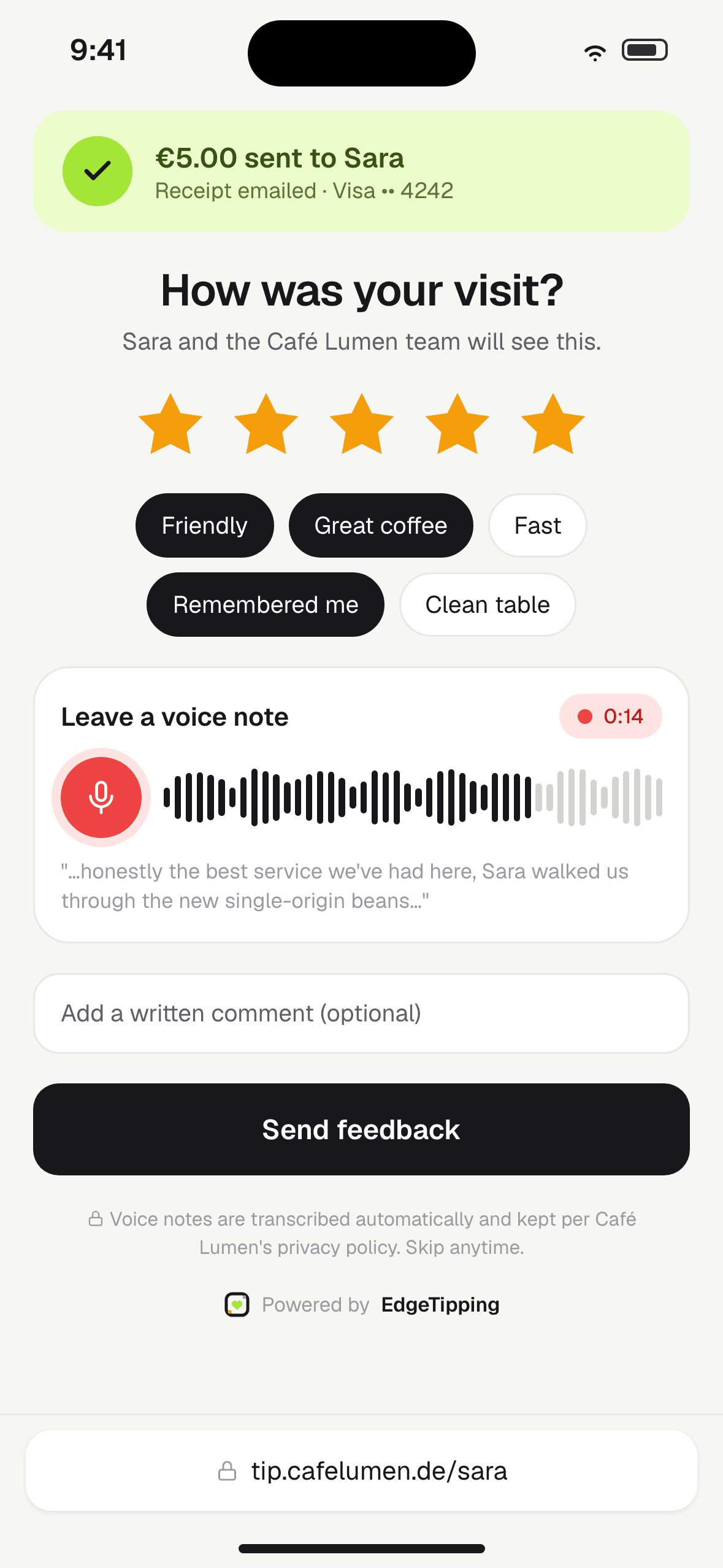
The customer can optionally provide a rating, written review, or voice feedback.
Recording
Payment, allocation, staff, restaurant, and feedback information is recorded according to the platform's data model.
Reporting
Authorized employees, restaurant managers, and platform administrators receive the appropriate views of transaction and tipping activity.
Reconciliation & settlement
Financial records provide the information required to reconcile transactions and their allocations, while actual fund settlement follows the configured Stripe payment architecture.
The solution
22 capabilities, from QR code to settlement.
Select an area to see how each capability works and the conditions it depends on.
01 / 5 capabilities
Organizations, staff pages, and QR access
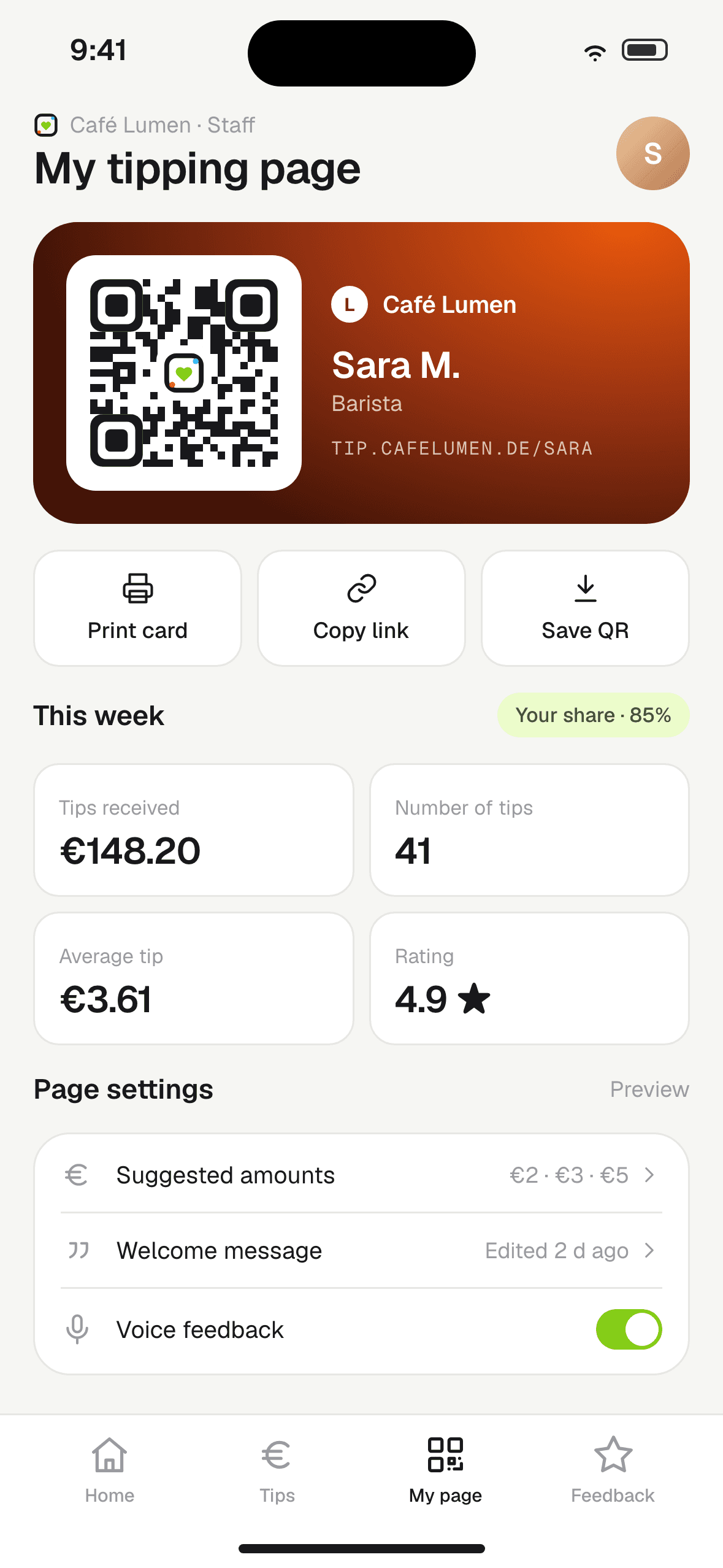
Every tip-eligible employee gets a branded page that opens straight from a QR code, printed on materials that match the venue.
Organization & restaurant management
EdgeTipping allows a business to create an organizational structure representing its restaurant, hospitality operation, or service organization. The organization can then manage individual staff members under the same account.
Each employee can have an individual profile and dedicated tipping experience while remaining connected to the parent organization. This gives management centralized visibility without eliminating the identity of the individual employee receiving the tip.
The organizational model also provides the foundation for payment distribution because each transaction can be associated with the relevant platform, business, location, and staff member.
Depending on the business, staff can include
- Waiters and servers.
- Baristas.
- Bartenders.
- Hosts.
- Delivery personnel.
- Service employees.
- Hospitality staff.
- Other tip-eligible team members.
Individual staff tipping pages
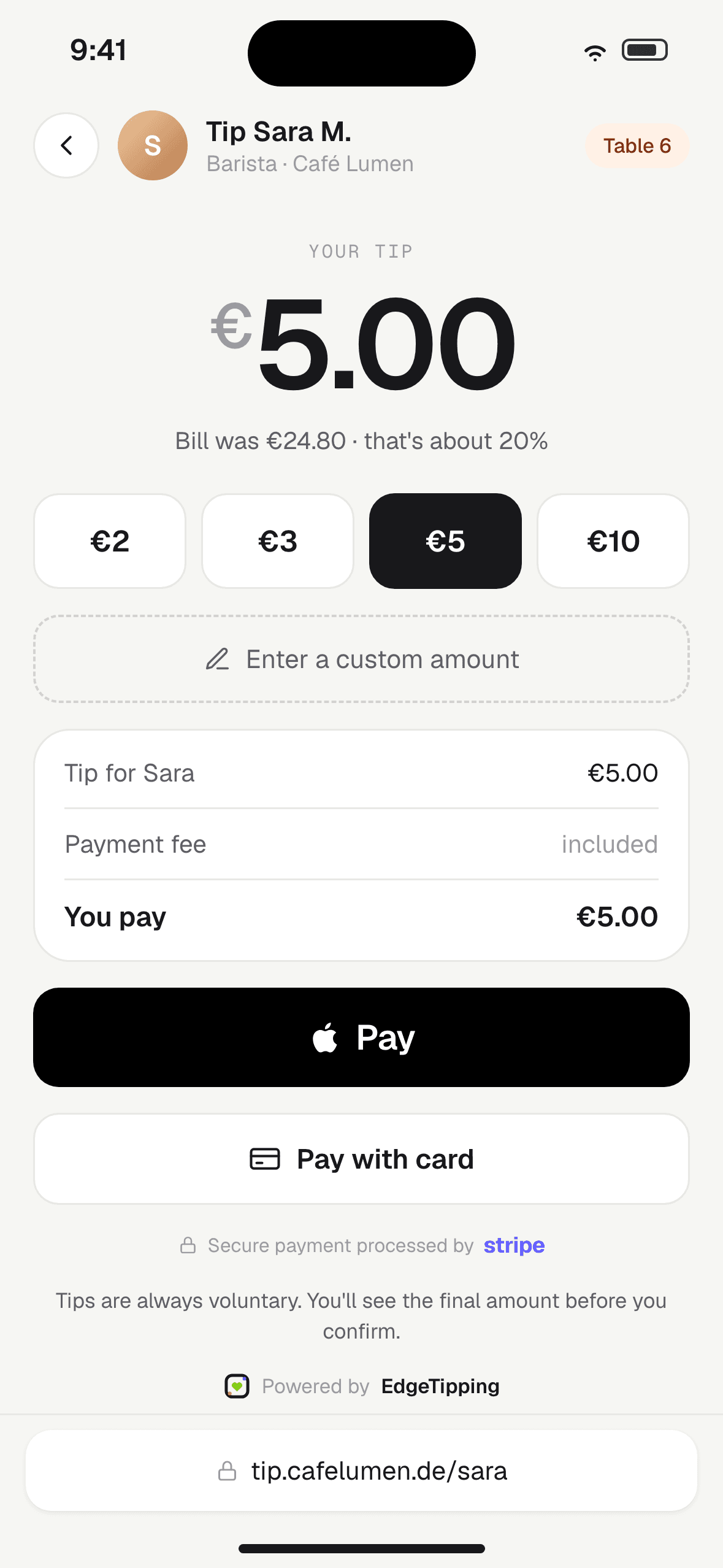
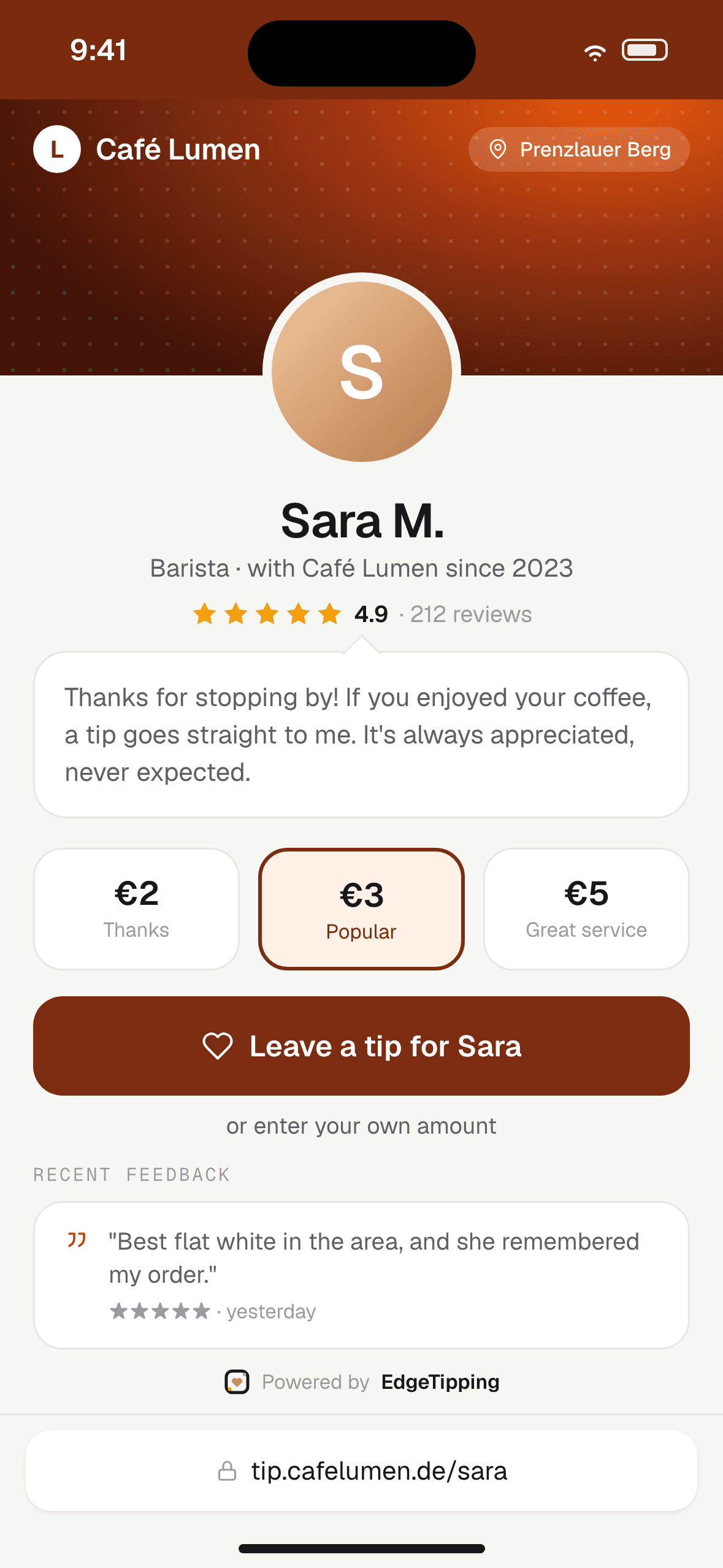
Each staff member can receive a dedicated digital tipping page. Rather than asking customers to navigate an application or search for an employee manually, the appropriate page can be opened directly through a QR code.
A simple interaction
- Scan
- Select Tip
- Pay
- Leave Feedback
The experience is designed to minimize friction between the customer's decision to leave a tip and completing the transaction.
The page can present
- Staff member identity.
- Profile information.
- Business or restaurant branding.
- Suggested tip amounts.
- Custom tip amount.
- Payment options.
- Feedback interface.
- Customer comments.
- Additional configurable information.
QR-based tipping
QR codes form one of the primary customer entry points into EdgeTipping. A QR code can be associated with an individual staff member or another configured tipping destination.
A customer scans the code using their phone and is taken directly to the corresponding tipping page. No manual search for the employee is required.
This makes digital tipping particularly practical in physical environments where the interaction between the customer and staff member may last only a few minutes.
Businesses can place QR codes on
- Restaurant tables.
- Receipts.
- Counter displays.
- Employee cards.
- Menus.
- Table tents.
- Printed signage.
- Delivery packaging.
- Hospitality rooms.
- Event materials.
Customizable tipping experience
EdgeTipping allows organizations to customize the customer-facing tipping page to better match their brand and service environment. Instead of sending customers to a generic payment page, restaurants can provide a tipping experience that feels like a natural extension of their brand.
This is particularly important because the tipping page may be one of the final digital interactions a customer has with the business after completing their meal or service.
Customization can include
- Restaurant branding.
- Logo.
- Staff information.
- Page presentation.
- Suggested tipping values.
- Customer messaging.
- Feedback prompts.
- Visual content.
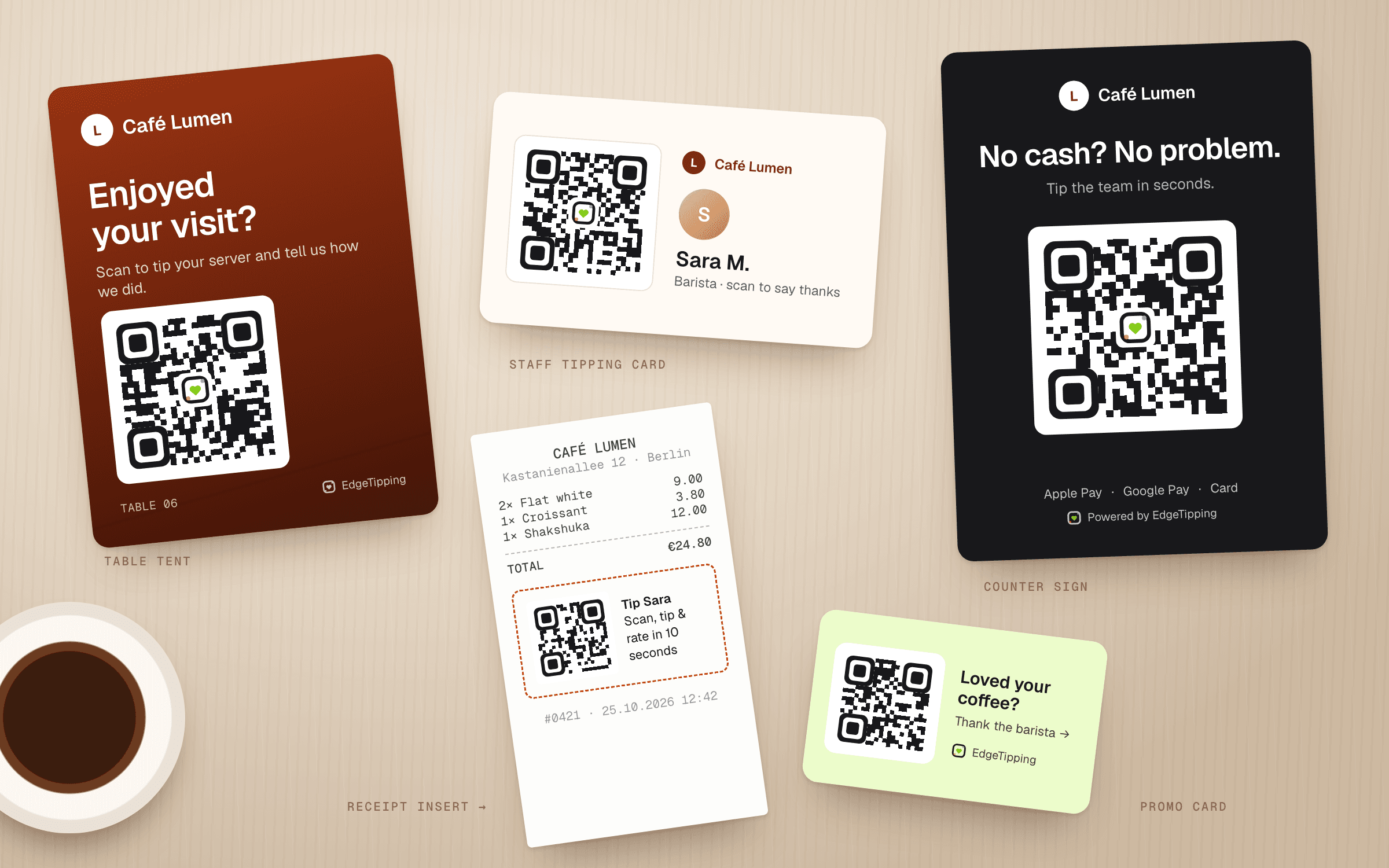
Customizable & printable QR materials
EdgeTipping does not treat the QR code as merely a technical identifier. Businesses can prepare the surrounding printed experience so that QR materials fit naturally into their physical environment.
The system can support customizable print layouts containing the appropriate QR code together with branding and instructions.
Organizations can customize the presentation before printing so that the physical and digital customer experiences remain consistent.
Materials restaurants can prepare
- Table cards.
- Staff tipping cards.
- Counter signs.
- Receipt inserts.
- Table tents.
- Small promotional cards.
- Other printable tipping materials.
Business value
Value for everyone around the table.
For restaurants
- Provide customers with a convenient cashless tipping option.
- Manage staff tipping from a centralized system.
- Customize tipping pages around restaurant branding.
- Collect customer feedback at a highly relevant moment.
- Monitor tipping activity through structured reports.
- Reduce manual calculation of multi-party tip allocations.
- Operate under configurable contractual payment rules.
- Integrate gratuity management with the broader restaurant ERP ecosystem.
For staff
- Receive a dedicated digital tipping page.
- Use a personal QR code for customer access.
- Reduce dependence on cash gratuities.
- Gain appropriate visibility into personal tipping activity.
- Receive direct customer appreciation and feedback.
- Benefit from a structured digital record of relevant gratuity transactions.
For customers
- Leave a tip without needing cash.
- Access the correct tipping page immediately through QR scanning.
- Choose their own voluntary tip amount.
- Complete payment through an integrated digital experience.
- Provide feedback within the same journey.
- Share richer feedback through text or voice where available.
For restaurant management
- Understand digital tipping activity across employees.
- Review customer feedback alongside gratuity patterns.
- Access historical tipping reports.
- Monitor applicable restaurant and staff allocations.
- Identify broader service trends.
- Reduce fragmented manual administration.
- Connect tipping information with other restaurant systems.
For the platform operator
- Manage multiple participating restaurants from a common platform.
- Define restaurant-specific commercial agreements.
- Configure platform, restaurant, and staff allocation rules.
- Track transaction-level distribution information.
- Monitor platform-wide payment activity.
- Reduce manual financial reconciliation.
- Support multiple business models without redesigning the tipping workflow for each customer.
Edgerunners' contribution
Designed and built end to end.
Edgerunners designed and developed EdgeTipping as an end-to-end digital gratuity and payment-distribution experience.
One of the platform's important architectural strengths is the connection between the customer-facing simplicity of tipping and the more complex financial workflow operating behind it.
- Product and UX design in Figma
- Cross-platform development with Flutter
- Restaurant and organization management
- Staff tipping profiles
- Dedicated tipping pages
- QR-based customer access
- Customizable QR print experiences
- Stripe payment integration
- Multi-party payment splitting
- Contract-based distribution rules
- Platform, restaurant, and staff allocation logic
- Transaction tracking and reconciliation support
- Staff and management dashboards
- Tipping and financial reports
- Customer feedback
- Voice feedback capabilities
- Integration architecture
- Connectivity with the EdgeRestaurant ecosystem
The outcome
EdgeTipping transforms gratuity from an informal cash interaction into a structured digital payment, distribution, feedback, and reporting ecosystem.
- Customers gain a fast and convenient way to recognize good service.
- Staff members receive dedicated tipping identities and clearer visibility into their digital gratuities.
- Restaurants gain centralized management, reporting, customer feedback, customizable branding, and integration with their broader operational ecosystem.
- The platform operator gains the infrastructure required to manage commercial relationships with multiple restaurants and apply configurable financial rules to each transaction.
Scan. Tip. Pay. Share Feedback. Done.
Behind that simplicity is a complete infrastructure for processing, distributing, tracking, and analyzing digital gratuities across multiple stakeholders.
Multi-party money needs careful rules.
Because EdgeTipping handles multi-party financial workflows, its payment architecture requires careful governance.
Stripe integration and any connected-account or payment-splitting functionality must operate according to the Stripe products available for the relevant business model, account structure, and jurisdiction.
Contractual distribution rules should be versioned and auditable so that the platform can determine which agreement applied when a particular transaction occurred. Changes to commission or allocation rules should not silently modify the historical interpretation of previously processed transactions.
Refunds, disputes, payment-processing fees, failed transactions, payout timing, and other financial events should be handled explicitly because they can affect the final amount attributable to each participant.
Customer feedback, particularly voice recordings, should be collected and retained according to clear privacy policies. Where recordings are transcribed or analyzed automatically, users should receive appropriate notice.
Organizations should consider the employment, payroll, taxation, tip-pooling, gratuity, payment-services, and reporting regulations applicable to their jurisdictions. EdgeTipping provides the technical infrastructure for processing and recording gratuity-related transactions, while the legal and accounting treatment of those funds depends on the operating model and location.
Role-based access should ensure that employees, restaurant managers, platform administrators, and financial personnel can access only the transaction, tipping, feedback, and organizational information appropriate to their responsibilities.


Let's talk
Building a payments or gratuity product?
From QR-based customer journeys to Stripe-powered multi-party distribution and reporting, we can help you design and build a voluntary-payment platform with the financial controls it needs.
Discuss your payment platformEdgeTipping — Digital tipping, payment splitting, and feedback management, by Edgerunners.