

Agentic Industrial Inventory Code Migration
A controlled multi-agent workflow that translates legacy inventory descriptions into a new coding standard — keeping uncertain decisions visible and reviewable.
- Multi-agent workflow
- Hierarchical standard
- Independent AI review
- Human-in-the-loop
Project overview
A new standard, without rebuilding the inventory by hand.
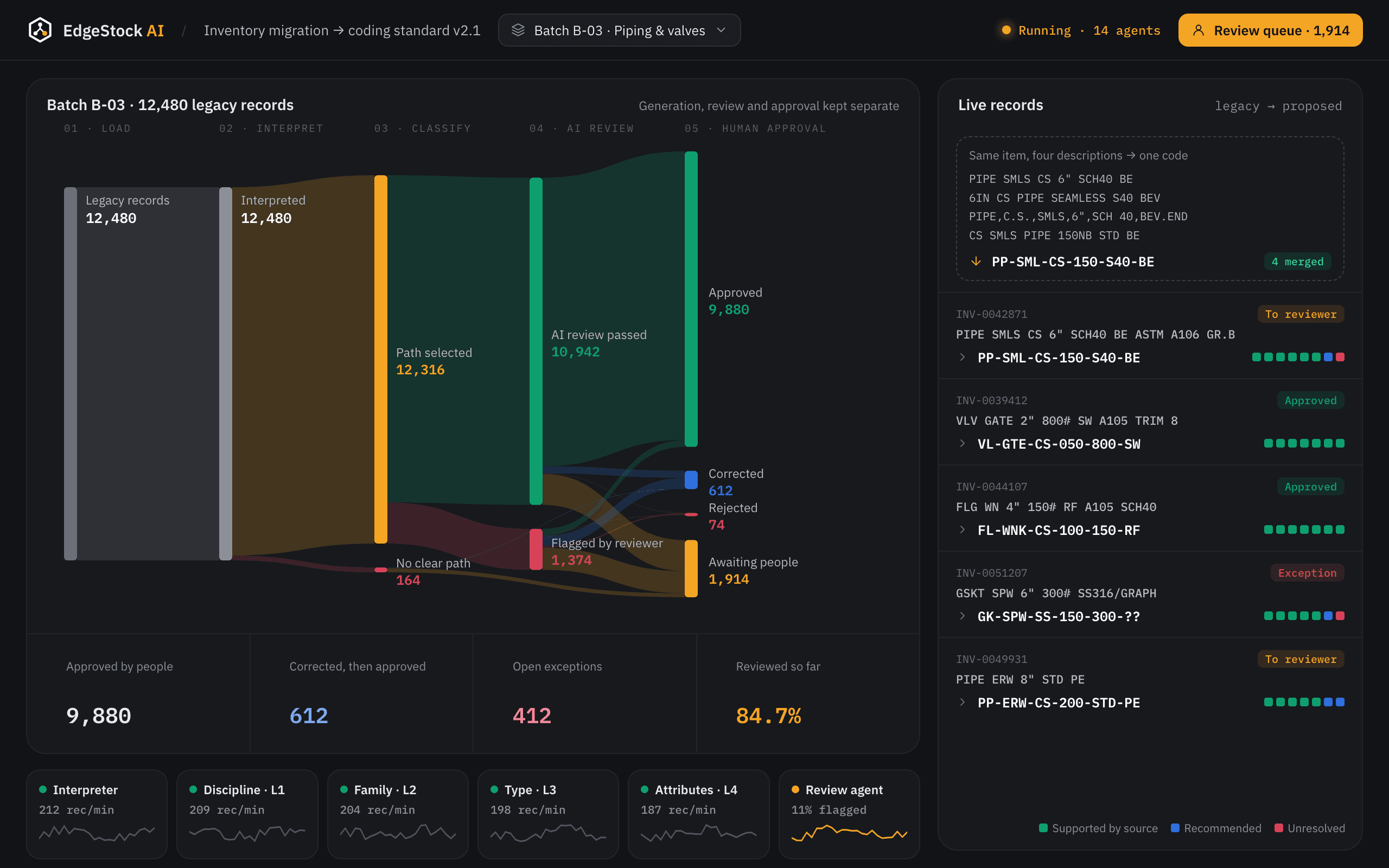
An oil and gas construction company introduced a new inventory coding standard with a different structure, classification hierarchy, and set of material attributes. Its existing records held highly technical descriptions — some attributes missing, others expressed inconsistently.
Instead of a complete manual reclassification or a disruptive warehouse inventory replacement, EdgeStock AI interprets legacy descriptions, populates the attributes the new standard requires, validates proposals, and flags uncertain cases for human review.
- PIPE SMLS CS 6" SCH40 BE
- 6IN CS PIPE SEAMLESS S40 BEV
- PIPE,C.S.,SMLS,6",SCH 40,BEV.END
- CS SMLS PIPE 150NB STD BE
One standards-aligned code with branch-specific attributes
Illustrative examples. Manual reclassification would consume engineering time and introduce inconsistencies across similar materials.
The solution
Generation, review, and approval — kept separate on purpose.
Rather than asking a single model to produce a replacement code unchecked, EdgeStock AI processes the target structure layer by layer, then hands the result to an independent reviewer — first an AI agent, then a person.
- 01 / Generate
Classification agents
Work through the target hierarchy layer by layer, populating each branch's attributes.
- 02 / Review
Independent review agent
Checks the proposal against the standard and the source, and explains potential issues.
- 03 / Approve
Qualified reviewer
Confirms, corrects, or rejects — with full visibility into evidence and uncertainty.
Walkthrough
Follow one record into the new standard.
Step through how a legacy description becomes a proposed code — and how each attribute keeps track of where it came from.
One record, step by step / Illustrative
01 / 06
Legacy record · INV-0042871
PIPE SMLS CS 6" SCH40 BE ASTM A106 GR.B
- Supported by source
- Recommended from evidence
- Unresolved
The record, code format, and values above are illustrative and do not represent the client's data or standard.
Confidence & uncertainty
Every value knows where it came from.
An incorrect material specification can affect procurement, compatibility, maintenance, or safety-related decisions. Making uncertainty visible lets reviewers spend their expertise on the records that need it, instead of inspecting everything with the same effort.
- Supported by source
Found directly in the legacy description.
- Recommended from evidence
Proposed from reference data; kept distinct from confirmed facts.
- Unresolved
Insufficient evidence — flagged for human review.
Core capabilities
Eight capabilities behind a controlled migration.
- 01
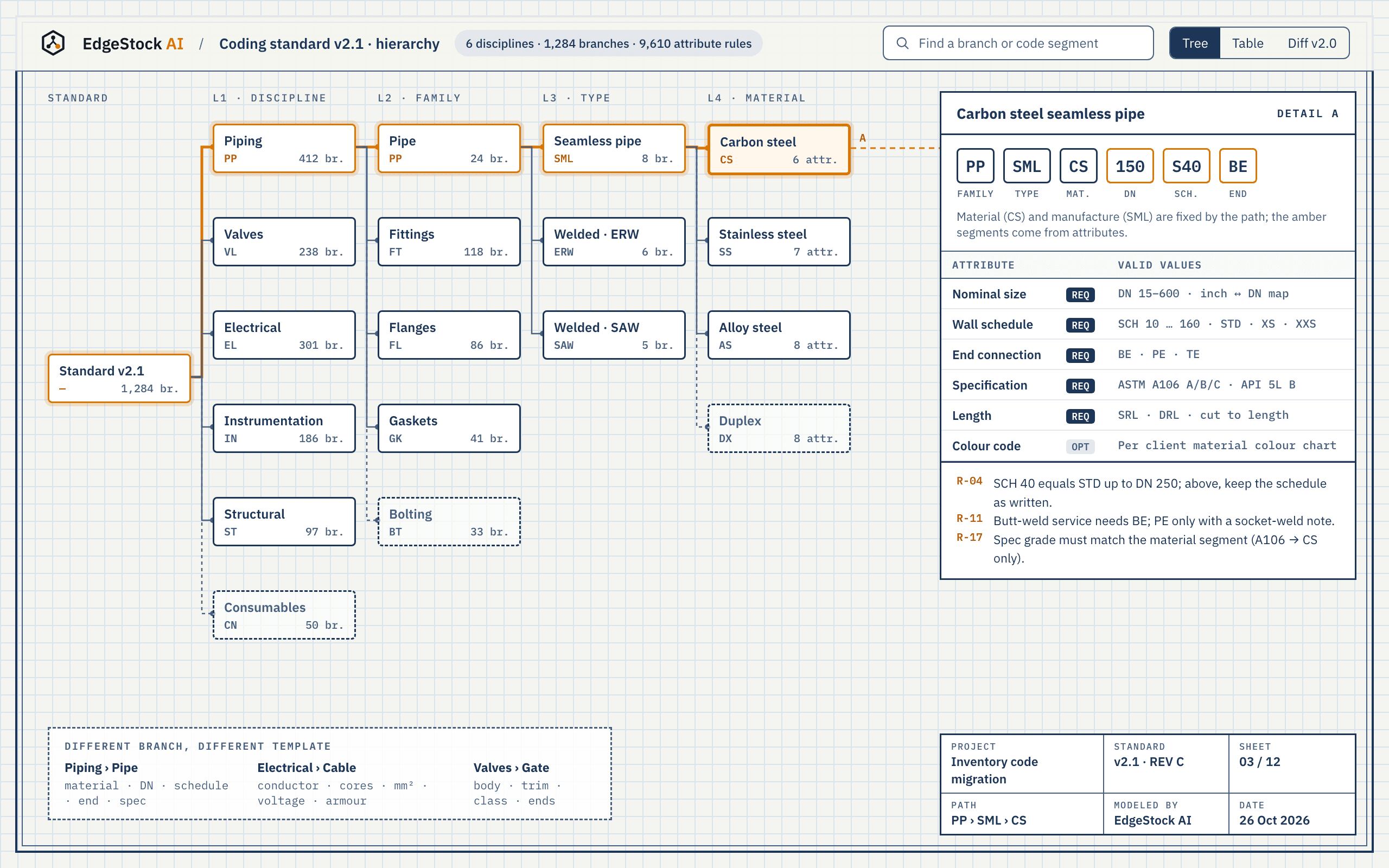
Hierarchical standard modeling
The new coding standard is represented as a classification hierarchy. Each branch defines its own required attributes, valid values, constraints, and rules — so a piping component and an electrical component follow different paths instead of one generic template.
- 02
Technical description interpretation
Legacy descriptions are analyzed for information relevant to the new standard and mapped to its terminology and attribute structure — interpreting technical meaning, not just renaming items.
- Material & composition
- Dimensions & nominal sizes
- Pressure ratings & grades
- Connection types
- Manufacturer / supplier
- Technical specifications
- Colour & category attributes
- 03
Layer-by-layer AI classification
A specialized agent processes each classification stage, considering the original description, the relevant technical rules, and decisions already made. The staged process stays aligned with the standard and exposes how each attribute was derived.
- 04
Missing attribute recommendations
When a required value is absent, the system can propose a candidate based on reference information, technical specifications, or market data — only when the evidence is sufficient.
A recommended value is always kept distinct from a confirmed fact and is never silently treated as verified material data.
- 05
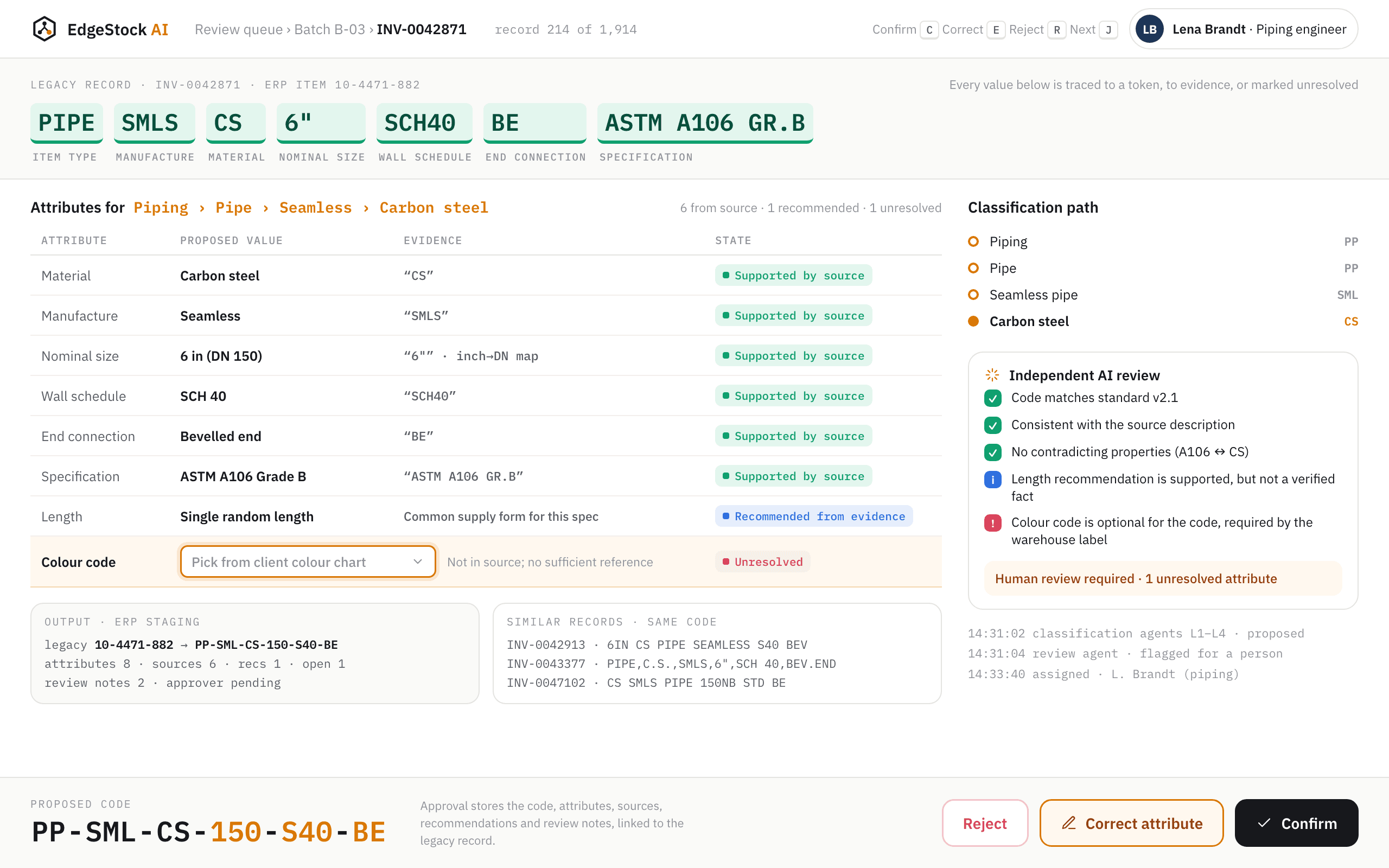
Independent AI review and validation
A separate review agent evaluates each proposal and explains which decisions deserve closer attention. Separating generation from review surfaces mistakes that would otherwise stay hidden.
- Code matches the standard
- Required attributes populated
- Consistent with source
- No contradicting properties
- Recommendations supported
- Ambiguity or operational risk
- Human review required?
AI review is an additional control layer, not a guarantee of correctness. Critical specifications still require validation against authoritative sources.
- 06
Confidence and uncertainty management
The system distinguishes information supported by the source, information inferred from evidence, and information that remains unresolved. Ambiguous cases are flagged rather than assigned unsupported values — so reviewers focus their expertise where it is needed.
- 07
Human-in-the-loop approval
Authorized users inspect the original description, proposed code, populated attributes, review findings, and reasoning — then confirm, correct individual attributes, or reject. AI handles repetitive interpretation; people keep accountability.
- 08
Structured output for inventory systems
Results include the proposed code, attributes, source information, recommendations, confidence indicators, and review notes — a consistent representation that supports controlled integration with downstream inventory or ERP processes.
How the agentic workflow operates
From manual exercise to controlled workflow.
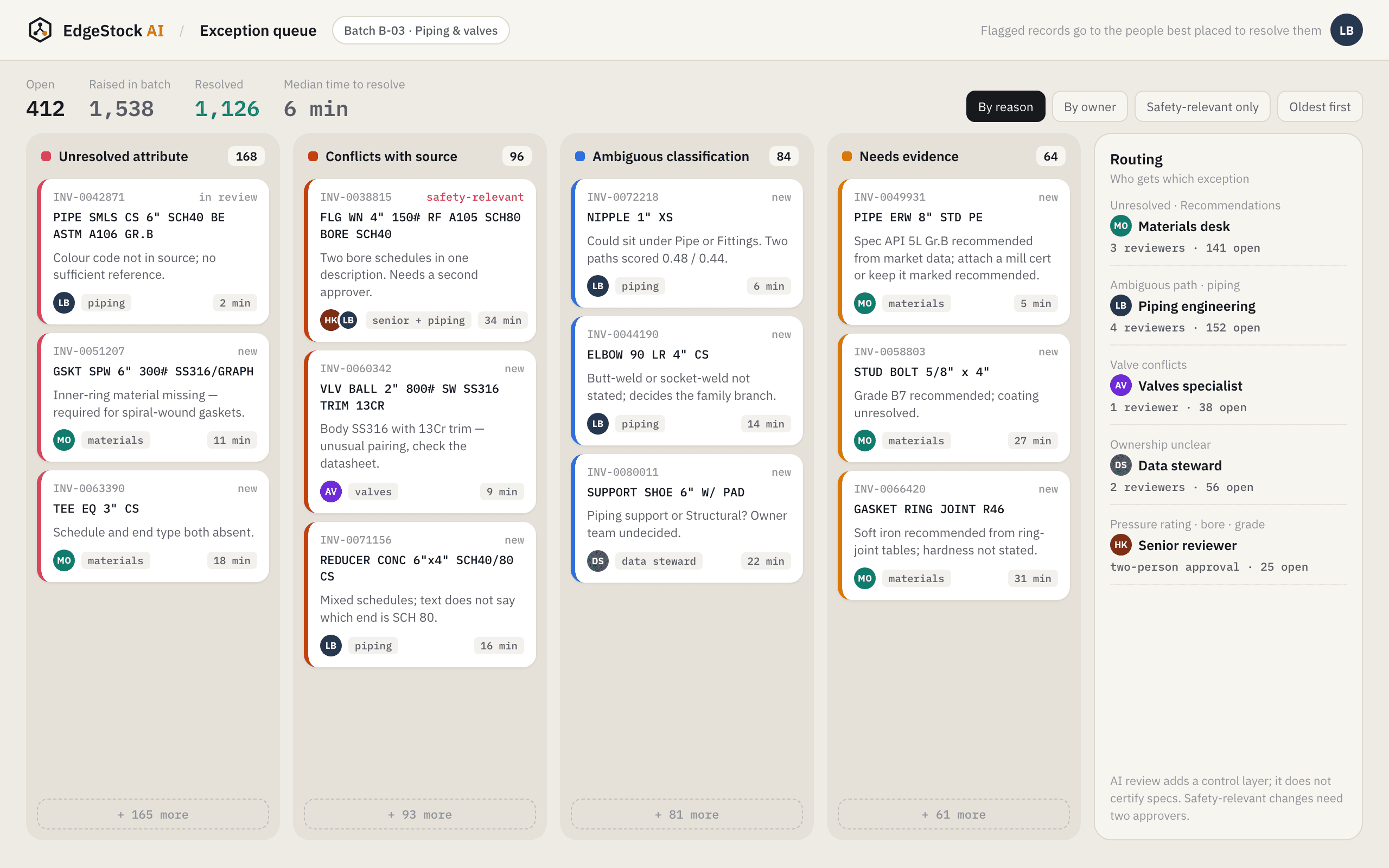
Nine stages with explicit validation and exception handling — and flagged records routed to the people best placed to resolve them.
Load the legacy data
Read the original inventory codes and technical descriptions.
Interpret the material
Extract identifiable properties from the source description.
Select the classification path
Determine the relevant branch of the new standard.
Populate attributes progressively
Apply specialized agents to the requirements at each level.
Identify missing information
Detect attributes that cannot be established from the source.
Generate evidence-based recommendations
Propose values only when sufficient supporting information is available.
Review the resultReview agent
A separate validation agent identifies inconsistencies, unsupported assumptions, and potential problems.
Present the decision for approvalHuman
Show the proposed code, attribute values, and review findings to an authorized user.
Record the approved mapping
Preserve the confirmed result for the migration workflow and downstream use.
A transition, not a rebuild.
Without automation, the company faced a substantial manual effort: reviewing records, creating classifications, reconciling mappings, and updating the operational system.
EdgeStock AI transforms existing data while preserving the relationship between each legacy description and its proposed replacement — reducing repetitive work while retaining the controls reliable industrial data migration requires.
Legacy code & description
Approved new code & attributes
- Source information
- Recommendations
- Confidence indicators
- Review notes
Structured output prepared for controlled integration with downstream inventory or ERP processes.
Product value
Less repetitive classification, more reliable data.
Reduced manual effort
Automates repetitive interpretation and attribute mapping across large inventory datasets.
Standards-aligned data
Structures legacy descriptions according to the new coding hierarchy.
Technical context preserved
Retains relevant information from detailed industrial descriptions.
Transparent uncertainty
Identifies missing, ambiguous, or insufficiently supported attributes.
Independent review
Adds a separate validation stage to detect potential inconsistencies.
Human accountability
Qualified users inspect, correct, and approve proposed mappings.
Migration continuity
A controlled transition without a wholesale manual reconstruction.
Reusable architecture
A pattern for other industrial classification and master-data projects.
Edgerunners' contribution
Agentic AI applied to a concrete enterprise data problem.
We designed and developed an AI-driven approach combining technical data interpretation, hierarchical classification, multi-agent processing, and human review.
Modeling the new inventory standard as a hierarchical classification structure.
Translating technical legacy descriptions into structured material attributes.
Developing a staged agent workflow to populate the required attributes.
Separating direct extraction from evidence-based recommendations.
Implementing a review-oriented workflow to identify uncertainty and potential inconsistencies.
Presenting explanations and review findings to support human approval.
Preparing structured mapping results for the inventory migration process.
Inferred attributes are recommendations, not verified facts, and AI review is not a guarantee of technical correctness. Critical specifications should be validated against authoritative documentation and approved by qualified personnel.
 Let's talk
Modernizing legacy master data?
EdgeStock AI's architecture can be adapted to other industrial classification and master-data transformation projects. Bring us your standard and your records — we'll help you design a migration where reasoning, uncertainty, and validation stay visible.
Discuss a similar migrationEdgeStock AI by Edgerunners — Agentic migration with reasoning, uncertainty, and validation in view.